News
Black Holes or Black Hole Stars? Astronomers Spar Over Webb Telescope’s ‘Little Red Dots.’
Astronomers built the James Webb Space Telescope to pick up faint light from the first billion years after the Big Bang, a chaotic era when vast swaths of hydrogen and helium gas gathered into the chains of galaxies...
Astronomers built the James Webb Space Telescope to pick up faint light from the first billion years after the Big Bang, a chaotic era when vast swaths of hydrogen and helium gas gathered into the chains of galaxies we see today. Even in the telescope’s first images, astronomers could see a whole zoo of mysterious smears of light.
One batch of objects proved especially difficult to interpret. They glowed blindingly bright, emitting red light with long wavelengths and shining as brilliantly as a whole galaxy. They were tiny, spanning just a pixel. And they were everywhere. A couple appear in almost every image Webb takes. In 2023, researchers started calling them “little red dots.” Astronomers have repeatedly pointed Webb toward the little red dots, wringing precious new information from these pixels of light.
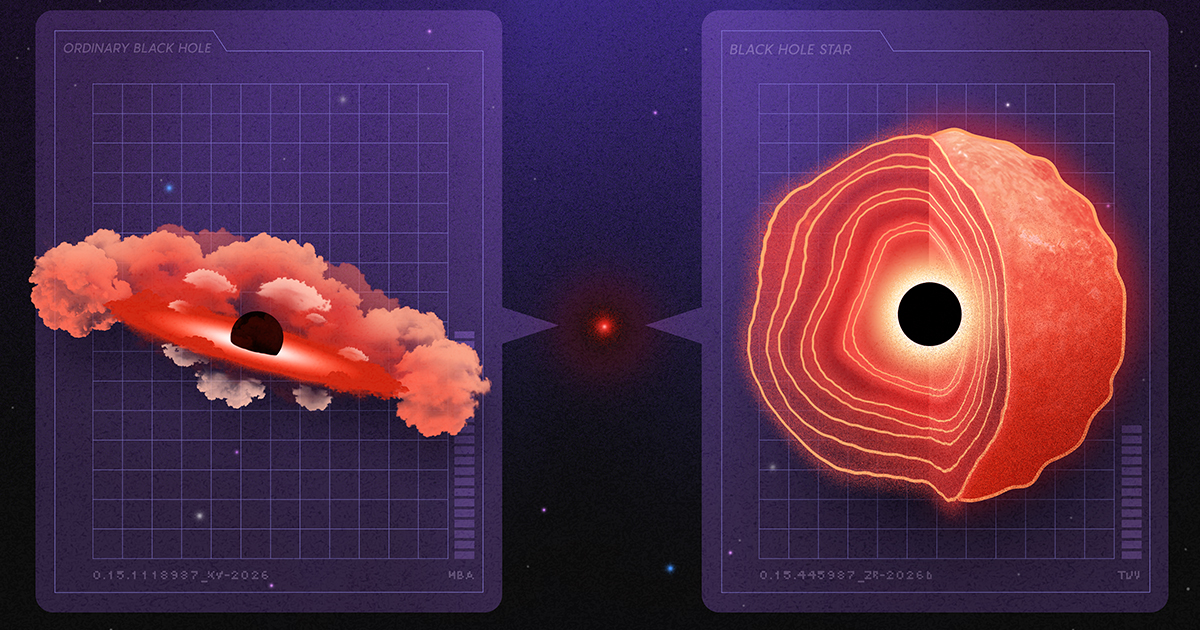
Initially, researchers thought the dots looked kind of like galaxies. Later, they concluded that little red dots look more like the supermassive black holes that sit at the heart of most galaxies. These monstrous masses are themselves dark, but their formidable gravity violently vacuums up gas and other nearby matter, generating rings of hot, swirling detritus that completely outshine the stars around them.
Then, in the spring of 2025, two teams of astronomers simultaneously announced observations of a pair of little red dots that were unlike all the rest. In fact, they were unlike any object ever seen.
“In all the millions of [observations] we’ve taken with ground-based telescopes,” said Anna de Graaff, a researcher at the Max Planck Institute for Astronomy in Heidelberg, Germany, and head of one group, “there’s nothing that looks like these sources.”
The two teams of astronomers propose that they are looking at a new astronomical object: a topsy-turvy lump of hydrogen that shines with the light of billions of suns while hiding a black hole deep in its core. They call it a black hole star.
Get Quanta Magazine delivered to your inbox
In a paper posted last week, astronomers took this analysis a step further. They argued that the Webb telescope is witnessing the births of supermassive black holes inside the cores of colossal stars. “There is a fundamentally new phenomenon afoot,” said Rohan Naidu, an astronomer at the University of Hawai‘i.
But not everyone agrees with this bold interpretation. It has sparked a flurry of follow-up research and reignited a fierce debate over the nature of these peculiar pinpricks of light.
“The field has gotten very polarized,” said Anna-Christina Eilers, an astrophysicist at the Massachusetts Institute of Technology who studies little red dots.
When all you can see is a speck, it’s hard to tell what you’re looking at. All you know about it is its color and brightness. Astronomers first argued that little red dots were distant galaxies on the cosmic horizon, mainly because of their brightness. But galaxies that bright would have to be huge — and there was no known way for them to grow so big in just hundreds of millions of years. Astronomers dubbed them “universe breakers” for the way they seemed to demolish the standard cosmic timeline.
Then they took a closer look. De Graaff led one survey, called Red Unknowns: Bright Infrared Extragalactic Survey (Rubies), and Naidu co-led another survey, called Mirage or Miracle (MOM). These were two of a wave of surveys that trained Webb telescope on distant objects, including little red dots, for hours at a time. They tabulated precisely what shades of light were coming from each dot, and how bright the shades were. This detailed color breakdown, known as a spectrum, told astronomers a far more detailed story than the initial observations had. Different atoms shine in subtly different hues, so the spectrum provided a sense of what the object’s particles were doing.
[Read Full Story on Quanta Magazine →](https://www.quantamagazine.org/black-holes-or-black-hole-stars-astronomers-spar-over-webb-telescopes-little-red-dots-20260914/)