News
Scientists Find First Adult T. Rex Trackway – And The Footprints Are Human-Sized
Very few, if any, animals single-handedly represent an entire geological episode lasting nearly 100 million years.
Very few, if any, animals single-handedly represent an entire geological episode lasting nearly 100 million years.
But Tyrannosaurus rex is no regular animal. Furthering that fact, a spate of recent findings has rekindled our childhood amazement of the Cretaceous period's most iconic poster child.
These revelations include evidence that T. rex spawned multitudinous, cat-like babies, and an evolutionary explanation for its much-mocked, chicken-winged physique.
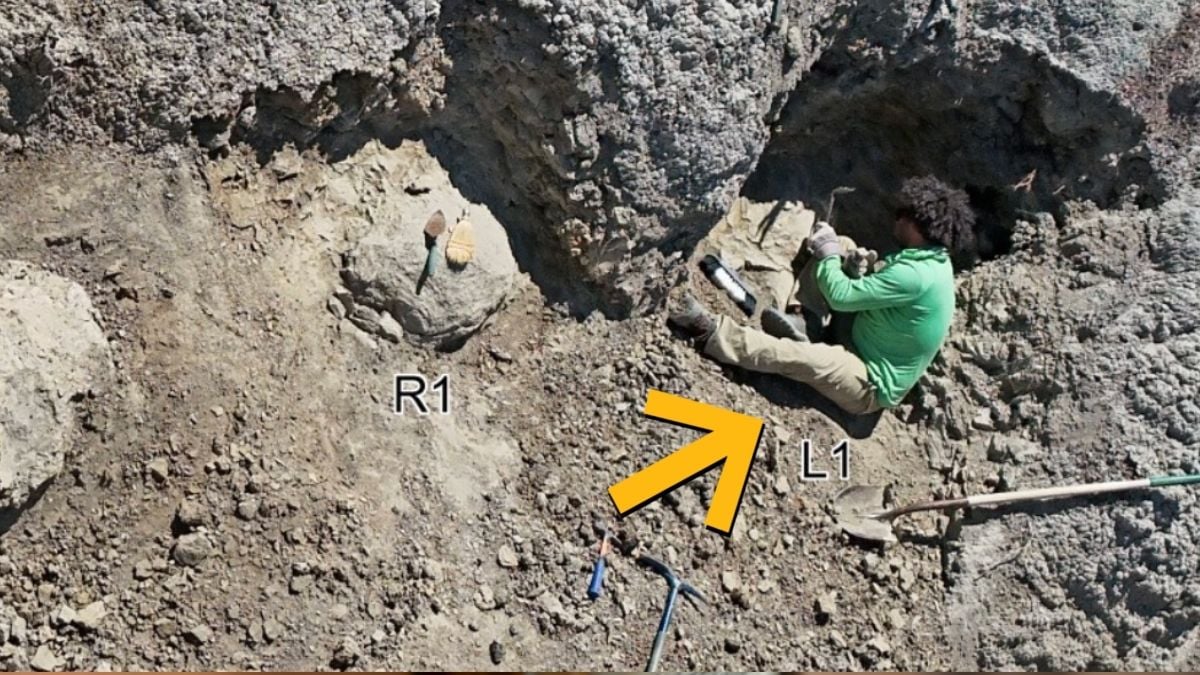
Fueling the fires of fascination, researchers have just reported one of the most revealing T. rex relics ever unearthed: a series of footprints left by this not-so-gentle giant as it stomped its way across a mystical land now known as North Dakota.
"Bones tell us an enormous amount about these animals, but footprints capture a moment of behavior," says Tyler Lyson, a senior curator of vertebrate paleontology at the Denver Museum of Nature & Science and one of the study's co-authors.
"With a trackway, we can actually follow an animal as it moved across the landscape. That is incredibly rare for T. rex."
And although paleontologists have unearthed a relative bounty of T. rex skeletal remains – but lamentably little sex stuff – they have found only a couple of isolated footprints (not tracks) attributable to this reptilian overlord, previously unearthed in New Mexico and Montana, the researchers point out.
So this finding is especially enlightening as the first and only known footpath made by an adult T. rex, recreated impressively in the Journal of Vertebrate Paleontology.
The researchers extrapolated its age to 66.5 million years ago, on the epochal eve of the fated asteroid strike that devastated the non-avian dinosaurs and prompted the Paleocene epoch.
Importantly, it's uncommon to find tracks and osteological (bony) fossil remains in the same place.
For one, they may each require different preservation conditions. Plus, trackways may be trodden upon by many living animals and therefore prone to destruction – imagine trying to find evidence of a long-gone hot dog at a state fair in the heart of seagull country.
Additionally, "footprints are not feet," the researchers note. So as sediments shift, the resulting track may not mirror the morphology of the feet that shaped it.
[Read Full Story on ScienceAlert →](https://www.sciencealert.com/scientists-find-first-adult-t-rex-trackway-and-the-footprints-are-human-sized)